Wednesday, June 22, 2011

Macchu picchu

Today was the day!
Getting to MP is not straight forward. First there is a two hour ride in a "collectivo". A collectivo is basically a mini bus that is used for localntransport. This was interesting because the countryside outside of Cuzco is green. The first forest I have seen in Peru. After the bus ride there is a 1.5 hour train ride to Agua Caliente, the town nearest to MP. A lot of people stay overnight in AC, and then get an early start the next morning. Also you can buy the entrance ticket to MP there. Luckily my travel agency did that for me.
By 7 this morning I was on another bus that took me the last stretch, 25 minutes, to the park entrance.
We had a small, 6 person, group with an English speaking guide. The weather was perfect, clear blue sky, and the views are spectacular. It's not an easy climb, but it sure is worth it. The setting is unique and spectacular. The site is on its own peak, which is surrounded by higher peaks in all directions. Below flows a river which was also sacred to the Incas. They viewed it as an earthly replica of the Milky Way.
It definitely is one of those views that stay with you.

Monday, June 20, 2011

Life is Good Again

It is amazing what daylight and a good nights sleep will do for you.
Last night was very frustrating. The internet wouldnt cooperate, even my Kindle quit on me.
I woke up this morning, and lo and behold the internet worked, and the sun was out.
I am definitely getting used to the altitude. I walked around for a good 5 hours without any bad effects.
I also had an uplifting experience. On my first day in Pisco I met three young ladies from Taiwan. We stayed at the some hotel, and obviously were hustled by the same travel agency, because we were on the same tours in Pisco and Nasca. Same tours, same buses, same hotels. We didnt separate until we reached Arequipa.
This morning, as I was watching a parade one of them greeted me, and we had a great time comparing notes. They recommended their tour company, and that set me up to see what I want to see.
They have been in Cuzco for several days, and had the same bus stories as I did. They were off to Machu Piccu today, and I will follow tomorrow.
Just an additional note. I was told this morning that Puno is completely shut down again. No ins, no outs. I guess I was lucky.
It has been a great day. I finally got my Peruvian haircut, 3 dollars.
Even my Kindle decided to wake up again. It will never replace books, but it is great for travelling.
This afternoon I went to Qorikancha. This was the central temple in Inca times. The temple walls were lines with 700 solid gold sheets, each weighing 2 kg. There were lifesize replicas of corn, of gold and silver, which were planted each year in a ceremony.There was also a fountain in the center, which was covered with an additional 55 kg of gold.
It didnt take the Spaniards long to liberate all this gold. They built a Dominican church on top of the Inca foundations, so a lot of the original walls are still visible. There was also a great show of modern art there today.
Great visit.
Tomorrow I am off to Machu Piccu. It takes a day to get to Agua Calliente where you stay overnight. Early the next morning you visit Machu Piccu, before returning to Cuzco, by train and bus.
Till later...

A Fathers Day to remember

There are a few things in life you shouldn't have to do more than once...root canals, dumping your canoe on the first day of a trip, and wearing wet clothes for a week, crawling along the tunnels in Vietnam, and taking a night bus in the Andes.
A double decker bus suddenly doesn't seem to be such a great idea. It's fine in the day when the scenery is spectacular and it's fun to look a couple of thousand feet down, while traveling on a dirt road. It's totally different at night. It's nice to look out and see fields, rocks, scenery. It is disconcerting to look out and see absolutely nothing, no road edge, nada.
For about an hour that was last night. You suddenly stop, as a passenger you see nothing. Then you see a huge truck creep by you, and the journey continues.
It wasn't supposed to be like that.
Puno has had a few problems the last month. Locals were protesting against a Canadian mining company's plan to open a new mine. The week before I left the town was completely shut down, tourists couldn't get in, and the ones there couldn't get out.
The situation improved and I had no problems getting in, but demonstrations started again, and there were road closures. On Saturday I went to a travel agency and she told me there was an express bus at 9 am arriving in Cuzco at 4 pm. The next morning she picked me up at my hotel with my ticket. She told me, that because of strikes the bus would have to detour, and it would add an hour to the trip.
Well, the trip ended up taking 13 hours, the great majority along narrow two lane gravel roads. To add some excitement one of the tires blew, and it took well over an hour to change. Looking at the other tires I was wondering which one might be next. I can't imagine doing this at night.
We did arrive in Cuzco at 10:30, and I was happy I had a hotel booked.
One Long Day!!!

Saturday, June 18, 2011

Lake Titicaca


I just got back from 2 fantastic days on Lake Titicaca.
We started our boat tour with a visit to the Uros Floating Islands. The Uros tribe has lived in this manner for 2000 years. There are many reeds in this area. The reeds have roots that form a dense 1 m thick mass. Every once in a while some of these masses float to the surface. The Uros then cut these root masses into squares. They then drive a post into the center of each square, and tie them together. This way the can have an island any size they want. The root masses are the covered with fresh reeds, laid in alternate directions. This layer is also about 2 m thick. Their houses are also built with these reeds. The island we visited had 4 families, with about 25 people. Once a week they travel to Puna. The rest of the time is "island" time. There are about 60 islands.
The Uros are short and stout. I wouldn't call them attractive. They do wear very colorful
outfits.
After our visit to the Uros we continued for 3 more hours to the island where we stayed overnight. The good news was that the accommodations were much better than I anticipated, actual beds, and some light, powered by a car battery. I had my own room.
The bad news that it was a half hour uphill climb. A young Chilean was kind enough to carry my bag. Without Javier I would still be somewhere on that hill.
Altitude adjustment is a real fact. Everything is a chore, and there are few level roads in Peru. Our landlady cooked lunch and dinner, very tasty soup and a veggie stew. All cooked the way it was done for the last couple of thousand years.
There is no relationship between the people and the Uros, different language, different culture, they don't even look the same.
There was an optional hike to the top of the island. I declined.
The sanitary facility was an outhouse. I found a chamberpot, so I didn't have to break my neck in the middle of the night.
In the morning, on the way to the outhouse I met the rooster, with the same intent as mine. The difference was that he didn't step into mine.
After a pancake breakfast, we hiked back down to the boat. Going downhill was even tough.
We then travelled for another island. Only an hour away, but completely different cultures.
We had the pleasure, thrill, ordeal, whatever you want to call it, of another one hour hike, uphill, of course.
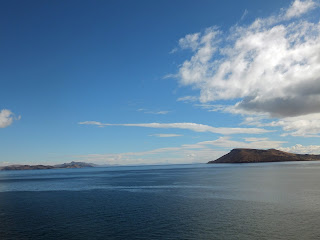
The nice thing was that I really started to appreciate the beauty of the lake. It is huge, a gorgeous blue, but cold. The temperature is a constant 8 degrees.
After a lunch of freshly caught lake trout we had the pleasure of 500 stone steps back down to the boat.
A three hour boat ride back to Puno ended the day.
You guys won't believe this, but I am spending 50 dollars on a hotel room. It even has an electric heater.
It's off to Cuzco tomorrow, unless there is a strike.
What will be, will be!!!,

Wednesday, June 15, 2011

June 15

I arrived back in Arequipa tonight, after two great days at the Colca Canyon.

We left yesterday morning, and drove through some more desert, but there was the odd water puddle. We saw quite a few picuyas, which are similar to llamas and alpacas. I learned the difference between those animals.
The biggest shock came when we crossed the highest point on the trip, at 5000 meters. We got off the bus to take some pictures, and as soon as I got off I felt woozy and light hearted. The altitude really hit me. Even at the Colca Canyon, which is lower, the effect was noticeable.
After lunch we spent some time is a hot pool. The water boils at 85 degrees here. It was the most relaxing hour in Peru so far. I went back to the hotel and went straight to bed.
NOTE TO MYSELF pack a bathing suit next time!!But nobody objected to my underwear.
I had read in another blog that when it's zero outside, it's zero inside. None of the hotels I have stayed in has heating. Their solution are blankets, very heavy, and lots. They must weigh 20 pounds.
We woke up at 5 am, had a quick breakfast, and then drove 2 hours over bumpy roads, to the condor viewing platform. The condors don't fly up, they let the warm air currents carry them up. We saw more than a dozen of these magnificent creatures. They reach a span of more than 3 meters. They sail back and forth, sometimes within 20 feet of the spectators. We spent about an hour watching in awe.
After that we had lunch on Chivay, went to the market, and then returned to Arequipa, a four ride from Chivay.
Oh, by the way, the cost of the two day trip was 25 dollars.
Tomorrow it's off to Lake Titicaca.

Monday, June 13, 2011

June 13

I visited a museum dedicated to "The Ice Princess Juanita". This is a 12 year old girl, of royal class, who was scarified to the gods. The Incas believed that mountains were livng gods. When volcanoes erupted it indicated that the gods were angry. This sacrifice was found on the top of the highest mountain in the region. Just the thought of such a journey is daunting. The body is one of 14 human sacrifices found in South America. This is the highest. The museum presentation was excellent, but no photos were allowed.
The rest of the day I visited some colonial houses, and I also toured the Cathedral.
Lots of photos.
Several bits of information. You can't get a real cup of coffee, it's all instant, served with condensed milk.
Every time you sign up for a tour, or just to buy a bus ticket, they ask your age. I have no idea why.
In Arequipa there are, literally, over 30 optical stores, smetimes 4 in one block. But I haven't found a barbershop yet.
The only thing pricey I have found are stamps. It's almost 2 dollars to send a postcard to Canada.
Last night I had a Chicha drink. It is grape colored and has quite a distinct taste, but it's good. I found out it was made from fermented dark corn. Another first.
Tomorrow I am off to the Colca Canyon.

Sunday, June 12, 2011

June 12 Arequipa

The overnight bus from Naxca to Arequipa was quite pleasant. The seats are like first class on a plane. I slept most of the way.
Today was more to my liking. Lots of walking. I arrived at my hostel at 8, but couldn't get on my room until 11. So I left my luggage and walked around town. I couldn't believe it, they actually had a parade for me. Military, boyscouts, girl guides; I was impressed. Arequipa is a lovely city, nice architecture, and the weather is perfect. High of 22, not a cloud in the sky, no humidity.
I spent the afternoon visiting the Monastery de Santa Catalina. This convent was started in the 1600's for the daughters of very wealthy Spaniards. It is huge, over 20 000 sq.m. It looks like fortress, with high walls all around.
The basic rule was that if a girl wasn't married by the age of 12, the parents would pay a dowery to the convent to accept their daughter. From 12 to 16 these girls were novices, and lived in their own part of the convent. At 16 they had to make a choice whether to become a nun or leave. It would be embarrassing to the family if she left. Once she became a nun she lived in the main part of the convent, never leaving it, even to go into town. The life style depended on the wealth of the family. Most nuns had their rooms and, if you could afford it, their own houses, within the convent, and they would have servants and slaves. At one time there were 80 houses in the convent.
In 1860 the church outlawed this type of extravagant life style for the nuns, and the convent closed for 100 years, and reopened as a museum in 1960. It is a beautiful place, lovely gardens, very peaceful.
In the evening I sat in the main
Plaza, in front of the cathedral, and watched the locals.
Tomorrow is another day.